
Imagine your customer opens a parcel to find a cracked screen, a shattered bottle, or a crushed gift box. That moment of disappointment is entirely avoidable, yet it happens thousands of times daily across London. Poor preparation is the single biggest cause of damaged deliveries, and the consequences go beyond a replacement cost. Poor packaging erodes customer trust fast. Whether you are a small business dispatching daily orders or an individual sending something precious, knowing how to prepare items correctly for a courier is the difference between a smooth handover and an expensive headache. This guide walks you through every step.
Table of Contents
- Gather your materials and check requirements
- Pack items securely for courier handling
- Seal and label your parcels correctly
- Avoid common mistakes and tackle special items
- Final checks before handover
- What most senders overlook and why it costs more than you think
- Need fast, secure courier delivery in London?
- Frequently asked questions
Key Takeaways
| Point | Details |
|---|---|
| Box strength matters | Pick the right box grade for item weight and fragility to stop damage in transit. |
| Buffer and pad thoroughly | Always wrap items individually and fill all empty spaces in the box. |
| Seal and label with precision | Use strong tape with the H-taping method and place labels clearly with a backup copy inside. |
| Avoid common mistakes | Don’t reuse weak boxes or underfill; check carrier restrictions before sending. |
| Eco-friendly benefits | Switching to sustainable materials meets regulations and appeals to delivery customers. |
Gather your materials and check requirements
Now that you recognise the risks of poor preparation, start with the right materials and awareness of packing limits. Rushing to the door with a flimsy bag and a strip of sellotape is a recipe for disaster. Before you pack a single item, gather everything you need.
Essential packing materials checklist:
- Sturdy cardboard boxes (single, double, or triple-wall depending on weight)
- Strong packing tape (at least 48mm wide)
- Bubble wrap, foam sheets, or packing peanuts
- Void fill (crumpled paper or air pillows)
- Fragile stickers and waterproof labels
- Polythene liners or zip-lock bags for moisture protection
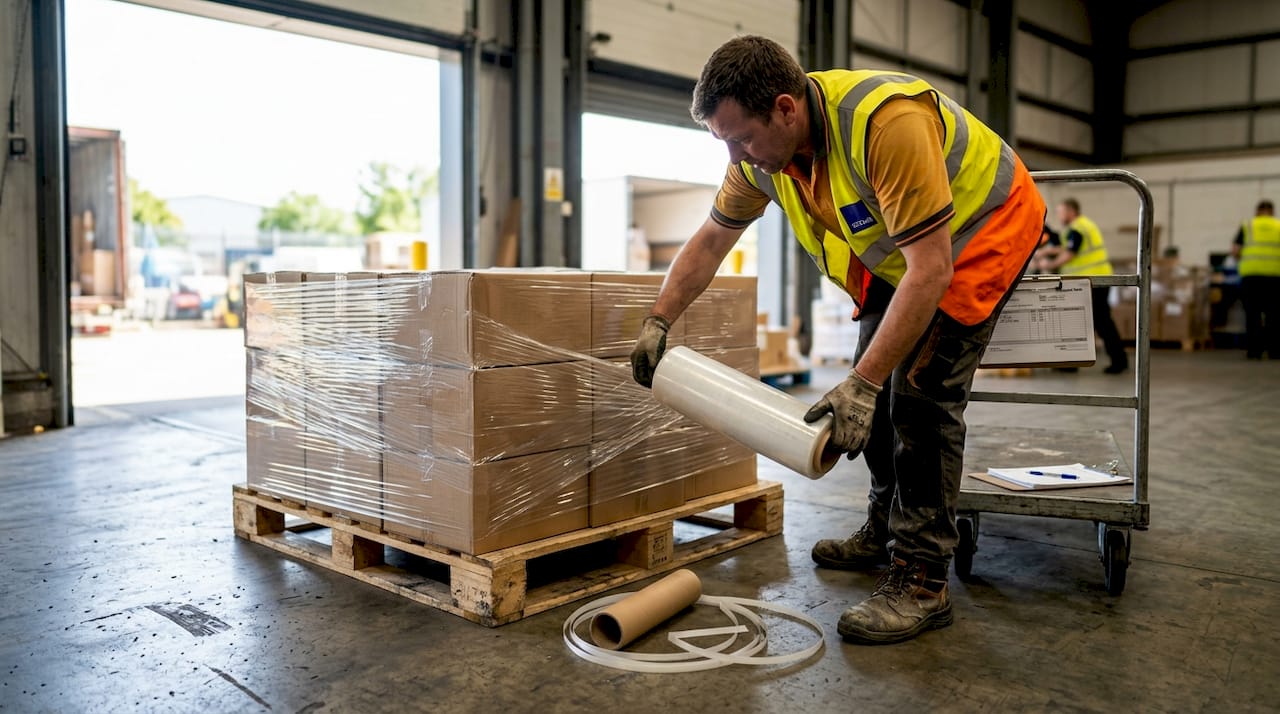
- Pallet wrap for bulk or heavy consignments
Box strength matters more than most people realise. Single-wall boxes suit items under 5kg, double-wall handles 5 to 15kg, and triple-wall is essential for anything heavier. Using an oversized box for a light item is just as problematic as cramming something into a box that is too small. Both create unnecessary movement and risk.
| Item weight | Recommended box type |
|---|---|
| Under 5kg | Single-wall cardboard |
| 5kg to 15kg | Double-wall cardboard |
| Over 15kg | Triple-wall cardboard |
| Bulk/pallet | Shrink-wrap and pallet board |
Carrier restrictions are another area where senders trip up. Measure and weigh accurately before booking, as carriers like DPD and Evri apply surcharges for incorrect dimensions or overweight parcels. A parcel that exceeds stated limits can be refused at collection or charged at a significantly higher rate.
Pro Tip: The UK Plastic Packaging Tax means that recyclable and recycled-content materials are not just environmentally responsible but increasingly a legal and commercial priority. Switching to eco-friendly void fill and recycled boxes now keeps you ahead of compliance shifts.
Pack items securely for courier handling
With materials in hand, move on to the actual packing, where technique makes all the difference. A well-chosen box means nothing if the contents are loose inside.
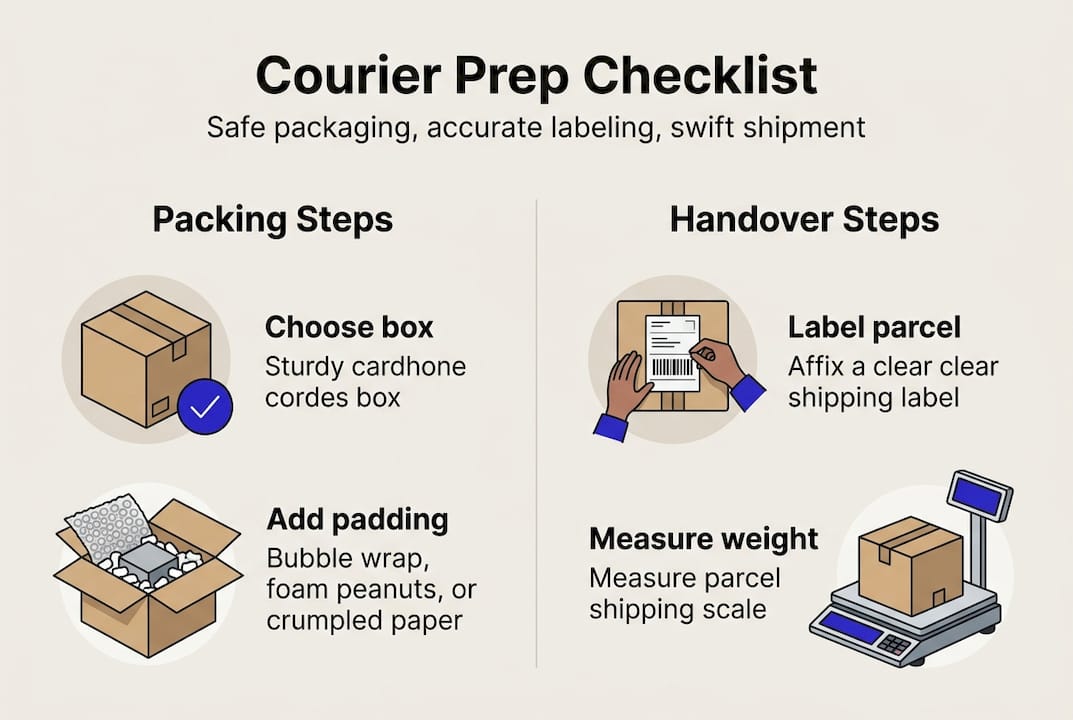
- Wrap each item individually. Wrap items in bubble wrap or foam and secure with tape. Never let two items touch each other directly inside the box.
- Create a cushioned base. Line the bottom of the box with at least 5cm of void fill before placing any item inside.
- Centre the item and fill all gaps. Once the item is placed, fill every void around and above it. Shake the box gently. If anything moves, add more padding.
- Keep items away from box edges. Maintain a buffer zone between the contents and the box walls to absorb impact from drops.
- Seal the box before labelling. Never label an open or partially packed box.
For electronics, remove batteries where possible and wrap circuit boards in anti-static foam. For glass or ceramics, the box-in-box method is the gold standard. Place the wrapped item in a smaller box, pad it thoroughly, then place that box inside a larger outer box with padding on all sides. It sounds excessive until you see how much pressure parcels experience during van loading and sorting.
For liquids and perishables, the approach is different. Use leakproof liners, insulation, and gel packs to maintain temperature and contain any spillage. A leaking parcel can damage other consignments in the same vehicle, which creates liability issues beyond your own delivery.
"For same-day London deliveries, compact and balanced packaging is not just good practice, it is a practical necessity. Courier vans are loaded quickly and driven through dense urban traffic. A well-packed parcel stays intact; a poorly packed one becomes a problem before it even reaches its destination."
Pro Tip: For SMEs dispatching multiple items daily, standardising your box sizes reduces packing time, lowers material waste, and makes van loading far more efficient for your courier.
Seal and label your parcels correctly
With items safely packed, ensure your parcels are sealed against leaks and labels are ready for intuitive courier handling. Sealing and labelling are where many otherwise well-packed parcels fail at the last moment.
- Use the H-taping method. Seal with H-taping by running tape along the central seam of the box top and bottom, then across both ends to form an H shape. This distributes stress across the box and prevents it from popping open under pressure.
- Avoid string, rope, or thin tape. These can catch on sorting machinery, cause delays, and void insurance claims.
- Apply your label to the largest flat surface. Never place a label on a seam, corner, or fold. Flat surfaces ensure scanners can read barcodes accurately.
- Include a duplicate label inside the box. Label clearly and include a duplicate inside, and remove any old labels from reused boxes. If the outer label is damaged in transit, the internal label allows the parcel to reach its destination.
- Remove all old labels. A parcel with two different addresses is a guaranteed misdelivery.
Correct labelling is one of the most undervalued steps in the process. For London same-day services, where parcels move through manual handling rather than automated sorting belts, a clear and well-positioned label means your courier can identify, load, and deliver without hesitation. Learn more about correct labelling practices and how they affect last-mile delivery outcomes.
Pro Tip: For high-value shipments, photograph the label and the sealed parcel before handover. This single habit has resolved countless disputes between senders, couriers, and recipients.
Fragile stickers do carry weight in manual courier systems, particularly for same-day London deliveries where drivers handle parcels personally. However, they are not a substitute for proper internal padding. Think of them as a signal, not a safeguard.
Avoid common mistakes and tackle special items
Even with correct packing and labelling, pitfalls remain. Here is how to sidestep them, especially for complicated or sensitive shipments.
Most frequent preparation errors:
- Using reused boxes that have lost structural integrity
- Leaving old address labels on the outside
- Underpadding items, particularly in corners
- Declaring inaccurate weights or dimensions
- Skipping internal duplicate labels
Poor packaging leads to 20% customer churn after repeated damage incidents. For a business sending even 50 parcels a month, that is a significant and avoidable loss.
| Shipment type | Key requirement | Common mistake |
|---|---|---|
| Standard goods | Appropriate box, void fill | Reused or oversized box |
| Heavy items | Triple-wall, pallet wrap | Insufficient base support |
| Perishables | Insulated box, gel packs | No temperature control |
| Fragile items | Box-in-box, 6cm padding | Single layer of bubble wrap |
| Liquids | Leakproof liner, sealed bag | No secondary containment |
For palletised goods, shrink-wrap the entire load and secure it to the pallet board with strapping. For cold-chain items, use insulated polystyrene boxes with enough gel packs to maintain temperature for the expected transit time plus a two-hour buffer.
On the sustainability front, the UK Plastic Packaging Tax incentivises businesses to shift away from virgin plastic materials. Recycled content packaging is no longer just an ethical choice; it is increasingly a financial one. Businesses that adapt now avoid future compliance costs and appeal to environmentally conscious customers.
Final checks before handover
You have packed, sealed, and labelled your shipment. Now confirm you have not overlooked a key protection step before the courier arrives.
- Inspect the exterior. Check for visible damage, weak corners, or tape that has not adhered properly. If the box looks questionable, repack it.
- Weigh and measure the final parcel. Confirm these match what you declared when booking. Discrepancies lead to surcharges or collection refusals.
- Verify all labels. Check the recipient address, postcode, and any special handling instructions. Confirm the barcode is unobstructed and scannable.
- Check the internal duplicate. Open and reseal if needed to confirm the duplicate label is visible and legible inside.
- Document high-value shipments. Photograph contents, packaging, and the sealed parcel. Note the declared value and confirm your courier's insurance covers it.
Proper preparation reduces returns, claims, and enables insurability, which matters enormously for businesses that rely on couriers daily. A five-minute checklist before handover can prevent hours of dispute resolution later. It also builds the kind of consistent reliability that keeps customers coming back.
What most senders overlook and why it costs more than you think
Most people treat parcel preparation as a one-off task. The businesses that do it well treat it as a repeatable system. That shift in thinking is where the real savings happen.
Fragile stickers are a good example. Many senders apply them and assume the job is done. In reality, a sticker without adequate internal padding is just decoration. The sticker signals intent; the padding delivers protection. Relying on one without the other is a false economy.
Double labelling and thorough documentation are similarly undervalued. We have seen small businesses lose client accounts not because a parcel was damaged, but because they could not prove how it was packed when a dispute arose. A photograph taken before handover, combined with an internal duplicate label, turns a he-said-she-said situation into a clear, resolvable record.
One London-based retailer we worked with was losing two or three clients per quarter to damaged deliveries. The culprit was not the courier. It was a habit of reusing boxes without checking structural integrity. Introducing a simple pre-handover checklist eliminated the problem within a month. Small habits, applied consistently, produce outsized results.
Need fast, secure courier delivery in London?
All the preparation in the world is most effective when paired with a courier service that handles your parcel with equal care. For those who want professional assurance, bridging the gap between meticulous prep and a seamless courier experience is straightforward.

At Track & Deliver courier service, we specialise in same-day and next-day delivery across London and the wider UK. Our team works with businesses and individuals who need reliable, insured handovers without the stress. Whether you are sending a single fragile item or managing daily bulk dispatches, we offer the speed, care, and accountability your shipments deserve. Get in touch today and experience what a properly supported courier handover feels like.
Frequently asked questions
What is the best type of box for courier shipments?
Single-wall boxes suit items under 5kg, double-wall handles 5 to 15kg, and triple-wall is essential for heavier parcels to withstand the rigours of courier handling.
How much padding do I need in my box?
Provide at least 3 to 6cm of buffer around all sides of your item and fill every gap to prevent movement during transit.
How should I label a parcel for a courier?
Label on the largest flat surface, never on a seam, and always include a duplicate label inside your package as a backup in case the outer label is damaged.
What packaging is needed for liquids or perishables?
Liquids need leakproof liners or sealed bags, while perishables require insulated boxes with gel packs to maintain safe temperatures throughout the journey.
Why do same-day London deliveries favour secure compact packaging?
Compact, secure packing speeds up van loading and prevents items shifting during urban driving, which is essential for the rapid turnaround that same-day services depend on.